This site uses cookies.
Click here to read our cookie policy and learn
how we use cookies and the steps we take to protect your privacy. Hide
this message
First Hand Case Study: Integrating Livestock into Arable at Biddesden Farm
Posted: 8th April 2026
Farm type: Mixed
Location: Hampshire
Size: 2300 Acres
Soil type: Mostly chalk with clay cap and flint
Mixes used: Red and white clover silage leys, cover crops
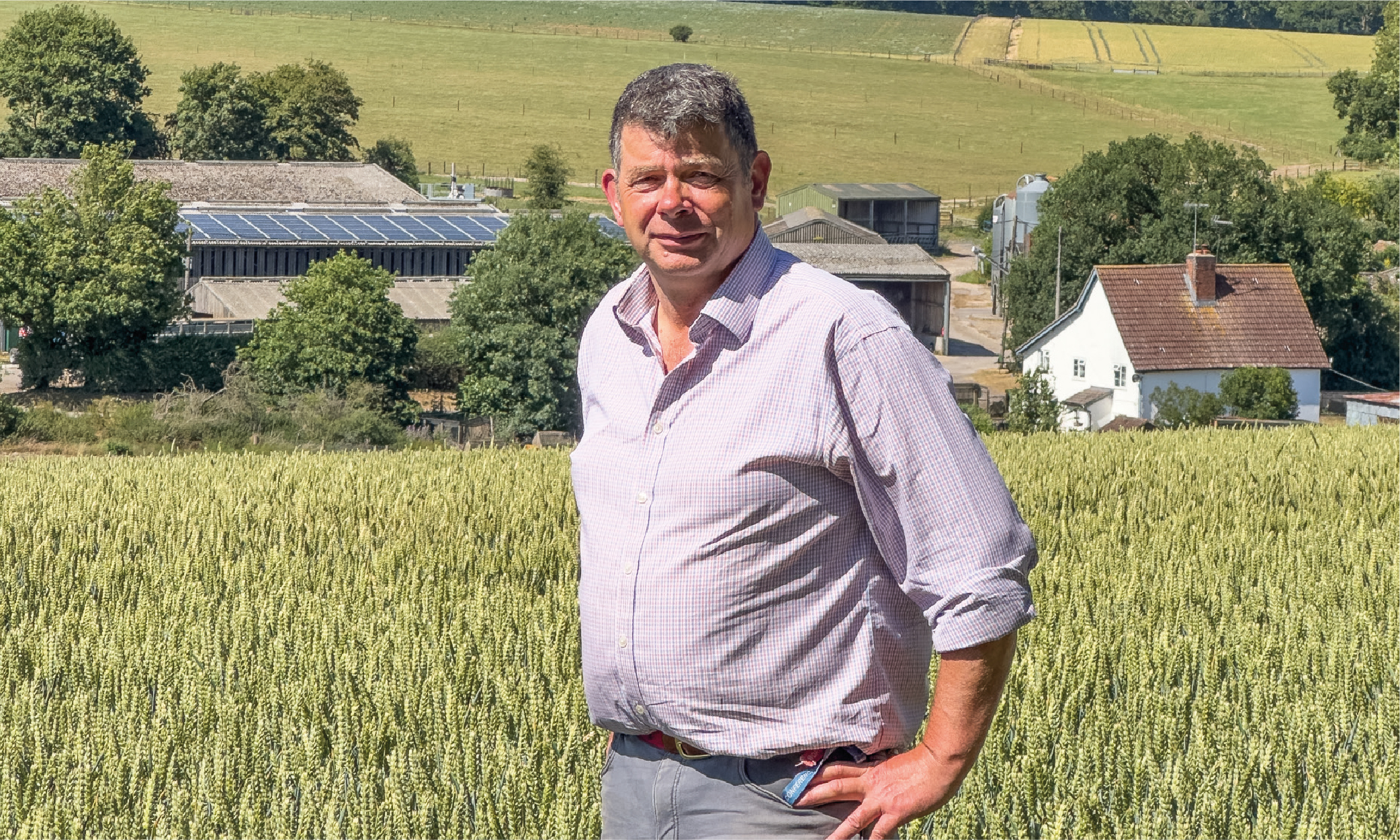
James Anderson is Farm Manager of the Biddesden House Farm Partnership, a 2300 acre estate just north of Andover, where ‘the ethos is to farm in the most sustainable way by integrating livestock enterprises into the arable rotation,’ James says.
The family who own Biddesden Farm have been on the estate since the 1920s and James himself has been managing the farm, ‘with a great team behind me,’ for nineteen years. The 2300 acres he oversees includes 400 acres which is contract farmed for a neighbour. James describes the operation as a ‘proper mixed farm’ which includes 180 pedigree Ayrshire dairy cows, 1200 ewes and 900 acres of arable crops as well as grass leys and maize for the cows.
‘We start calving in August going through to almost Christmas, trying to get as much from grass as possible,’ says James. ‘The cows are milked twice a day, averaging between seven and a half thousand litres which is sold as liquid milk to Muller. We have three main enterprises – cows, sheep, and arable,’ James explains. ‘And our goal is to integrate them to improve the farm and get it all working together.’
To this end, high clover cutting mixes rotate around the arable cropping, generally following a cereal. Traditionally these mixes were based on red clover. Recently, white clover has been added to fill out the base of the sward and James has also established a mix relying solely on alsike clover, to allow ewes to be grazed without the worry of fertility issues associated when grazing red clover heavy mixes.
‘The two-year red clover silage mix is used to make first class, first cut silage’, James says. He aims to take the first cut in early May and then holds back for the second and third cuts to ‘let the clover really come through’. In the second year, ewes and lambs are turned out onto the ley, with the aim of fattening the lambs as quickly as possible. ‘As the lambs get sold, the leys are sprayed off and then direct drilled with the wheat.’
Cover crops are also utilised ‘in front of all the spring cropping’ as part of the countryside stewardship scheme, with turnips added to the mix to help raise the nutritional value for the ewes, pre-lambing.
A further protein heavy silage is produced from 30 acres of herbal leys, these mixes have a strong lucerne inclusion, which replaced a straight lucerne crop, ensuring a high protein crop and an SFI payment.
‘Going forward we hope to be utilising herbal grazing based mixes to enable us to introduce beef animals into our arable rotation with a longer term view of soil improvement, and also giving us the opportunity to limit the amount of marginal arable break crops,’ James says.
His aims for the future are to ‘move towards crop establishment with less disturbance to the soil’, helped by soil conditioning from the leys grown on the arable ground. Historically we’ve ploughed but in the last 10 years we’ve moved towards a min till type establishment with success. About seven years ago we purchased a Mzuri Drill and moved into strip tilling all our arable crops. We’re now strip tilling our maize with a Kuhn Striger strip tillage machine and a standard maize drill and we’re looking at minimal disturbance for the grass seed establishment.’
James’s longer term goals are clear. ‘Ultimately, as a farming business, we’re trying to do our best for the environment and the soil and make it as future-proofed as possible, while also trying to be profitable.’
The clover rich silage and grazing leys from Cotswold Seeds are an integral part of the rotation and he’s made of the most of advice from the technical team.‘We use Cotswold Seeds because they’re very helpful and there’s a lot of knowledge behind the catalogue,’ James says. ‘Things turn up when they say they’re going to turn up and nothing’s too much trouble.’