


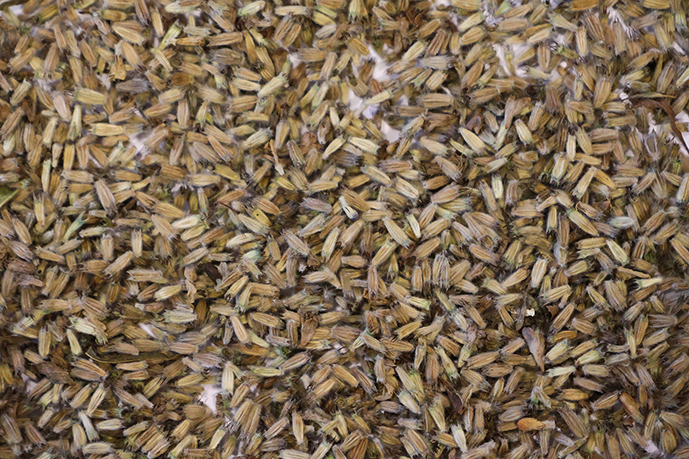
 Seed
SeedDevil's-Bit Scabious
Devil’s-bit Scabious is a slow growing, clump forming perennial. This is not an uncommon wild flower that thrives on soils lacking in nutrients and provides a late-summer flowering.
Uses
It provides a highly valuable late source of pollen and nectar for bees, butterflies and moths.
Persistence
This is not an uncommon wildflower however it has declined in parts of England nearly to the point of becoming threatened, due to it being a perennial it will grow back each year it just takes longer to establish.
Strengths
Devil’s-bit scabious is a great way to encourage pollinators to visit your wild flower area.
Frost Tolerance
This is a hardy, frost tolerant species.
Ideal Sowing Time
The seed is best sown in early spring.
Management
Some grassland management is required to maintain suitable habitat conditions for this species to thrive alongside other wildflowers.
Distinguishing characteristics
SeedSeed
The seeds are long/pointed and covered in very fine hairs with an awn and are incredibly light.
Flowering Plant
A rather hairy perennial up to 3 feet high. Its florets are all the same length and have almost all untoothed leaves. The lowest leaves are long and rather narrow and up the stem are pairs of smaller leaves. The flower-heads are surrounded by 2 or 3 rows of hairy bracts, and at the base of each individual floret is a bract as well as a toothed calyx.
Additional Info
Flowers: July to October Some other names used for Devil's-bit scabious are blue buttons, blue caps, of-bit and blue kiss.
Works well with
Meadow buttercup and sheep's sorrelYou can find Devil's-Bit Scabious in the following mixtures
History
Devil’s-bit Scabious has been used for many purposes over the years such as seasoning, dye, tea and medicinally to treat skin conditions. Its name is thought to come from its short root; the devil is said to have bitten it off in a rage at its ability to cure ailments!
Related Articles

Cotswold Grass Seeds, Cotswold Business Village, London Rd, Moreton-in-Marsh GL56 0JQ
Web design and development by Pixel Concepts


